
Rabbits
Poultry
Laying hens
Quails
Guinea pigs
Pigs
Ostriches
Sheep and goats
Pigeons
Pheasants
Forest animals
Parameters of poultry housing facilities
Before starting poultry farming, a breeder should obtain as much information as possible related to the specific species being kept—its characteristics, feeding habits, and, last but not least, the requirements that the housing facility must meet. This article focuses specifically on housing, or rather, on the equipment and parameters of poultry facilities.
General Conditions for Poultry Housing
Before building a housing facility, it is necessary to determine how many animals will be kept in the given space. Will the facility serve only for overnight housing, or will the birds remain inside for longer periods during the winter months or during the breeding season when they are grouped into breeding flocks without access to an outdoor run?
General rules for constructing animal housing include ensuring a dry, well-ventilated environment without drafts, with good natural lighting and windows ideally facing southeast to provide maximum sunlight exposure inside the coop. These basic parameters apply to all types of poultry. Poultry can be divided into ground-feeding (scratching) birds and waterfowl, as their ethological needs differ.
If both groups are kept at the same location, they should be housed in separate coops and, ideally, separate outdoor runs. It is advisable to install lighting with a timer in the coop to extend daylight hours during the winter months, which helps stimulate egg production. Housing for both ground-feeding poultry and waterfowl should be insulated to prevent temperatures from dropping below freezing. This is especially important for chicken breeds with large combs to prevent frostbite, and also during the laying period of hatching eggs to avoid damage caused by chilling.
Ground-Feeding Poultry
The housing parameters for ground-feeding poultry are as follows. Birds must be allowed to perch, as this is a natural part of their behavior. Perches should be installed as the highest point in the coop, spaced approximately 40 cm apart. The perches should have a rectangular or batten shape, generally about 4 cm wide, with rounded edges. Under no circumstances should perches have a circular cross-section, as increased pressure could lead to deformation of the breastbone.
The width and strength of the perch must be adapted to the size and weight of the species and breed. For example, wide and sturdy perches are necessary for Narragansett turkeys, where males can reach weights of up to 20 kg. In contrast, bantams, which weigh less than one kilogram, require narrower and less reinforced perches.
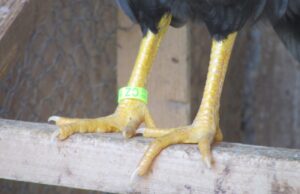
It is advisable to install a dropping board under the perches, where manure accumulates while the hens are roosting. This makes cleaning the coop easier.
Another essential piece of equipment is nesting boxes. There are several options. Litter-based nests with straw, suitable especially for birds intended for natural rearing, where hens incubate and raise their chicks themselves. Non-litter systems, more suitable for laying hens producing table eggs, as they reduce contamination of the eggs.
It is also recommended to place feeders and drinkers inside the coop. This prevents access by wild birds to the feed, protecting the flock from feed losses and from the introduction of infectious diseases. It also encourages poultry to return voluntarily to the coop.
Today, there is a wide range of feeders available on the market. These can be used for mash or pelleted complete feed mixtures, while others are suitable for homemade feed blends. Additionally, a smaller feeder should be provided with grit or dried crushed eggshells as a source of minerals. The drinker should be easy to clean and should always provide the poultry with sufficient clean, safe water.
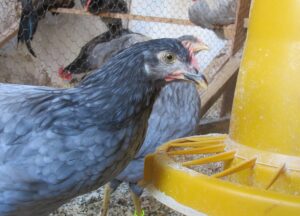
Suitable bedding for a chicken coop may include, for example, chopped straw, wood shavings, or dried grass from a lawn mower.
Waterfowl
The requirements for housing waterfowl are not as demanding, since ducks and geese do not roost. In the case of Muscovy ducks, however, it is advisable to install a wider perch at a height of around 50 cm, which provides females with a means of escape from males, as the males have a higher sexual drive and frequently chase the females.
The basic equipment of the housing facility also includes a feeder and a water container. The water container should ideally be placed on a grate, in a tray, or in a basin to help prevent the bedding from becoming excessively wet.
During the laying period, nesting boxes with bedding made of straw or dry old grass are essential. For ducks or Muscovy ducks, a sufficiently large plastic barrel can easily be used as a nesting box, cut to a height that allows the female to enter comfortably. The barrel or other nesting box may be placed either on the ground or on a raised platform. For geese, the nest should always be placed on the ground; for example, a plastic fruit crate is suitable. Such nesting boxes offer a significant advantage in that after the young have hatched, they can be easily cleaned and thoroughly disinfected. A thicker layer of straw is recommended as bedding.
Ideally, and if conditions permit, these housing facilities should be connected to a free-range area or an aviary.
Related posts
21. August 2026
Poultry belongs to the group of farm animals with a very intensive metabolism, which is the foundation of their high productivity. The rapid growth of broilers, high egg production in laying hens, and good reproductive performance of breeding stock are the result of long-term genetic selection, high-quality nutrition, and proper flock management. At the same…
27. May 2026
In small-scale farming practice, the term grit refers to insoluble mineral material that poultry ingest to mechanically process feed in their digestive tract. It is therefore a physically acting component that supports digestion. Typically, it consists of small stones (often siliceous gravel). On the other hand, there is limestone (calcium carbonate), which also fulfills a…
3. March 2026
Sprouted cereals are a simple way to enrich the feed ration, especially for poultry. Thanks to the germination process, nutrient digestibility increases and their availability improves. However, they are not a substitute for a complete feed mixture, but rather a suitable supplement when used properly and hygienically.
23. February 2026
In small-scale livestock farming, smaller quantities of feed mixtures are often used. Therefore, it is not uncommon for a farmer to have some pellets or loose feed mixture left even after the (expiration) minimum shelf life date. Is it still possible to feed such feed to the animals?
5. December 2025
In small-scale farming, it is common to encounter situations where breeders offer animals a smaller amount of complete feed mixture than recommended by the manufacturer, and replace the rest of the feed ration with grains such as wheat, barley, or corn. Grains certainly have their value in feeding, but on their own, they are not…
Related products
POULTRY UNI 30
A mashed concentrate for fattening of all categories of poultry, which includes the highest quality soja. It is mixed with cereals in a ratio of 20-40% (by type or phase of fattening). It contributes to fast growth and a high meat content. It does not contain coccidiostats.
BROILER MAXI
Feed for the final phase of fattening broilers. Supports a high meat content and a delicate meat taste. Start using it 5 or more days before slaughter. Does not contain coccidiostatics.
BROILER MIDI FORTE
A granulated feed mix for the intensive fattening of broilers from 15 days of age to a minimum of 5 days before ending feeding up. The Coccidiostat included lowers mortality during fattening. For the next phase of fattening Broiler MAXI is a suitable mix.
BROILER MINI FORTE
A ground feed mix with Coccidosistats, for the intensive feeding of broiler chickens up to 14 days of age and a support to fast growth a an excellent state of health in your broliers-
DUCK MINI
A high quality ground mix for fattening ducks and geese up to their 2nd week. It is suitable for fast growth and high meat content.
TURKEY MAXI
Feed for the final stage of turkey fattening. Use from the 13th week of age. It does not contain a coccidiostat.
TURKEY MIDI FORTE
A high quality granulated feed with coccidiostats for feeding turkeys from 5 to 12 weeks of age. It is the basis for fast growth, high meat content and an excellent state of health of your turkeys. The coccidiostat content lowers mortality during feeding. It continues on from feeding with Turkey Mini Forte. The live weight for turkeys at the end of this period should be around 7 kg for hen turkeys and 10 kg for cocks.
TURKEY MINI FORTE
A ground mix with Coccidiostats for fattening turkeys up to an age of 4 weeks. It is the basis for high meat content. Afterwards use the Turkey Midi Forte mix.
DUCK MAXI
A granulated mix for feeding ducks and geese from 3 weeks of age up to slaughter. The nutrients it contains support fast growth, a high meat content and a delicate meat taste.