
Rabbits
Poultry
Laying hens
Quails
Guinea pigs
Pigs
Ostriches
Sheep and goats
Pigeons
Pheasants
Forest animals
Hay and straw in rabbit nutrition
The digestive tract of the rabbit is naturally adapted to the intake of large amounts of roughage. These abilities originate from its wild ancestor, which had mainly various grasses and shrubs available in its natural habitat. However, with the domestication of the rabbit and subsequent breeding, the diet has shifted toward more concentrated forms of feed, enabling rabbits to achieve higher live weights, better weight gains, and thus improved production performance.
However, it can be stated that the ability to adapt to different feeds is only limited. In general, the rabbit can be considered a very sensitive animal with regard to diet composition and quantity. Any sudden change in composition or quality is usually quickly reflected in their health status, as well as in the economics of production.
Dry roughages are of fundamental importance in rabbit nutrition, mainly due to their high fiber content, but also because of the possible presence of certain beneficial components. Hay and straw in particular belong to this group of feeds. It is difficult to imagine keeping rabbits at home—especially in traditional small-scale systems for exhibitions or meat production—without hay and straw.
Hay
Hay is dried green forage. Its quality depends on many factors, such as the type of stand (monoculture or meadow mixture), altitude, phenological stage at cutting, geological subsoil, level of rainfall, etc. From the perspective of small-scale rabbit farming, meadow hay is of primary importance and is used most frequently. Its advantages include better availability, easier handling, and lower leaf loss during drying and transport. For rabbits, a mixture containing various herb species is also beneficial, as many herbs have favorable pharmacological effects (e.g., yarrow, dandelion, etc.). A disadvantage is the lower yield.
Hay from monocultures, mainly alfalfa or clover, is advantageous in terms of higher yield and nutrient content (especially higher crude protein content). However, there is often greater leaf shatter loss; it is more susceptible to absorbing atmospheric moisture, and these forage crops also require better growing conditions. Alfalfa or clover hay is used to produce meal, which is a major component of pelleted rabbit diets. The development of diets that retain the original structure of fibrous components can also be positively acknowledged, although the availability of such diets is limited.
Straw
Straw is a by-product of cereal cultivation. Its quality is mainly influenced by climatic conditions during the growing season, harvesting method, the time loose straw remains in the field after threshing, and storage duration and conditions. The poorest quality straw comes from uncovered stacks, where significant mold development often occurs. On the other hand, high-quality, dry straw collected from the field shortly after threshing and stored in a covered, dry, and ventilated place can be considered an excellent source of fiber. Unfortunately, good-quality straw is often underestimated in rabbit nutrition. Rabbits generally consume it more readily than average-quality hay.
In general, rabbits should have regular access to good-quality hay or straw. Ad libitum access to hay throughout the day is possible; however, this often leads to spoilage due to trampling and contamination with feces or urine, which can be considered a health risk, especially for young rabbits. Therefore, even in small-scale rabbit farming, hay should be “dosed” according to the observed interest of specific rabbits, while still being available to them for a longer period during the day.
Related posts
23. February 2026
In small-scale livestock farming, smaller quantities of feed mixtures are often used. Therefore, it is not uncommon for a farmer to have some pellets or loose feed mixture left even after the (expiration) minimum shelf life date. Is it still possible to feed such feed to the animals?
10. April 2024
Keeping dwarf rabbits as pets is becoming increasingly popular. It does not require a lot of space and is ideal for people who live in smaller homes or apartments. Dwarf rabbits are also very friendly, so it’s no wonder that people are choosing them for this purpose more and more often. As with all animals,…
30. August 2022
In this article we will discuss several rabbit diseases – ear scab, tyzzer’s disease and heat stress.
24. August 2022
In this article we look at two diseases – e.Coli and enterocolitis.
2. August 2022
In this article we look at two common rabbit diseases, myxomatosis and infectious rhinitis.
Related products
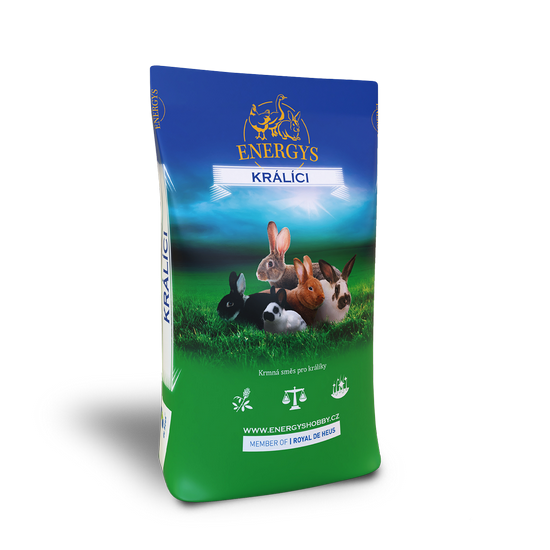
RABBIT DWARF
Complete pelleted feed for dwarf rabbits with high digestibility. It contains a high proportion of fibre (high alfalfa and grass cake content) and a reduced sugar and starch content. Contains flaxseed, which has a positive effect on coat quality. Suitable for daily feeding. We recommend providing rabbits with safe fresh water and hay.
RABBIT CHAMPION
Feed for show rabbits, does not include Coccidiostat. A unique mix significantly supports the quality and growth of fur. Serve when moulting and at least two months before the start of the show season.
RABBIT GOLD FORTE
A premium feed mix in an ideal make up for gestating and breast feeding females. For the intensive fattening of rabbits for a period of up to 5 days before slaughter. It supports fast growth, meat content and an excellent state of health. It contains a coccidiostat which lowers the risk of mortality.
RABBIT KLASIK FORTE
Intended for the fattening of rabbits up to a point at least 5 days before slaughter. Suitable for attaining a high meat content and an excellent state of health. Thanks to its Coccidiostat content it lowers the animals mortality.
RABBIT KLASIK
For the final phase of rabbit fattening, a minimum of 5 days before slaughter. It supports high meat content and excellent taste qualities in rabbit meat. Without a coccidiostat.
RABBIT START
For young rabbits from the start of accepting feed to 4-6 weeks after weaning. The feed helps to significantly lower the death rate in the period around weaning. It contains a raised percentage of fibre and less starch. It does not contain a coccidiostat.