
Rabbits
Poultry
Laying hens
Quails
Guinea pigs
Pigs
Ostriches
Sheep and goats
Pigeons
Pheasants
Forest animals
Hobby Sheep Breeds
Racka sheep resemble a woolly antelope in appearance. The horns are also exceptional in the Jacob breed. The smallest breed kept in our country is the Ouessant sheep.
Racka Sheep
Hortobágy Racka, Hungarian Racka or Hungarian Zackel – these are all names for an original Hungarian sheep breed that resembles a woolly antelope in appearance. In our country, it is kept mainly in zoos, but it is gradually gaining admirers among hobby breeders as well.
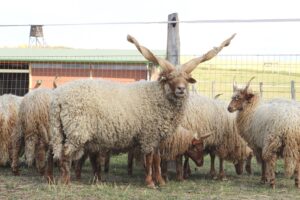
It is a primitive, coarse-wooled, hardy and robust breed with triple-purpose utility. In its country of origin, two varieties are described: the white Racka and the dark – black – Racka, which is rarer. It is small-framed, with ewes weighing between 45 and 55 kg and rams up to 75 kg. The fleece is mixed and hanging, white, coffee-golden, or black in colour. A distinctive breed feature is the long, upright spiral horns which, in the original type, grow at an angle of about 45° and adorn the heads of both sexes. In rams they may exceptionally reach up to one metre in length, while in ewes they are about half as long.
Jacob Sheep
The horns are also exceptional in the Jacob breed, which most likely originates from present-day Syria, where it is said to have been kept as long as three thousand years ago. The breed is even mentioned in the Bible (Genesis 30–31), where it is described that Jacob received these sheep from his father-in-law while working for him. Another historical account states that some of these sheep were washed ashore from shipwrecks during the invasion of the Spanish Armada in the reign of Elizabeth I..
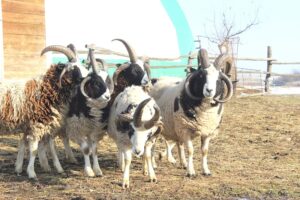
In any case, due to their multiple horns and exotic appearance, Jacob sheep have been bred for several centuries on farms in England, where they were brought from the Middle East via North Africa, Sicily and Spain. They are therefore considered an English breed.
The advantages of this breed include very good productivity, resistance to harsh climatic conditions, and tasty lean meat. They were first imported into the Czech Republic in 1997 from the Netherlands.
Ouessant Sheep
The smallest breed kept in our country is the Ouessant sheep, which originates from the island of Ouessant off the coast of the Brittany peninsula. It is an undemanding breed, with rams weighing between 15 and 22 kg (ewes 12 to 16 kg) and a withers height of 42 to 49 cm (ewes 40 to 46 cm). In the Czech Republic, Ouessant sheep have been bred since 2004; they are used for grazing gardens as well as kept as pets.
Related posts
3. March 2026
Sprouted cereals are a simple way to enrich the feed ration, especially for poultry. Thanks to the germination process, nutrient digestibility increases and their availability improves. However, they are not a substitute for a complete feed mixture, but rather a suitable supplement when used properly and hygienically.
23. February 2026
In small-scale livestock farming, smaller quantities of feed mixtures are often used. Therefore, it is not uncommon for a farmer to have some pellets or loose feed mixture left even after the (expiration) minimum shelf life date. Is it still possible to feed such feed to the animals?
30. April 2020
Racka sheep resemble a woolly antelope in appearance. The horns are also exceptional in the Jacob breed. The smallest breed kept in our country is the Ouessant sheep.
19. September 2019
Due to the growing human population and the shortage of sources of protein, goats, as undemanding but highly productive animals, will become increasingly important to man, who they have served for thousands of years. What to feed goats and how to take care of them?
12. September 2019
Dairy breeds (White and Brown short-haired, Anglo-Nubian, Alpine and Saanen), meat breeds (Boer), combined breeds (Valais), fibre-producing breeds (Cashmere, Angora) and dwarf breeds (Dwarf Dutch) are all kept in the Czech Republic due to their range of use.
Related products
SHEEP UNI
A supplementary feed mix for weaning and fattening sheep and goats. It can also be used for lamas. The feed is treacled and also suitable for gestating and milking animals. The substances contained in it support their excellent state of health a required breeding results.
LAMB
A starter for lambs and kids suitable from the first week to the 3rd week of age. First it is added to milk, later it is combined with hay. It supports the growth of a paunch, the growth of bones and muscle.