
Rabbits
Poultry
Laying hens
Quails
Guinea pigs
Pigs
Ostriches
Sheep and goats
Pigeons
Pheasants
Forest animals
Feed labelling – what does the label tell us?
Feed labelling is an important part of the system for controlling the quality and safety of feed mixtures in the Czech Republic, as it provides breeders with key information about the composition, nutritional value, and use of the feed. All this information can be found on the label.
In the Czech Republic, the Central Institute for Supervising and Testing in Agriculture (ÚKZUZ), which operates under the Ministry of Agriculture, plays a key role in feed quality control. This government authority focuses on monitoring the quality and safety of agricultural products, including feed intended for livestock in small-scale farming – poultry, rabbits, and other farm animals. It checks whether feeds comply with established requirements and contribute to the protection of animal health. Part of this control also involves monitoring how feeds are labelled and what information manufacturers provide on packaging. The label on feed packaging is referred to as an “etiketa.” The manufacturer is responsible for correct feed labelling, as stipulated by the Feed Act. The label must contain clear and understandable information. Based on this information, the breeder can better assess whether the feed is suitable for their animals and at the same time be assured that the product meets the required legislative standards.
The label must be truthful, clear, and must not mislead the buyer. Mandatory information includes: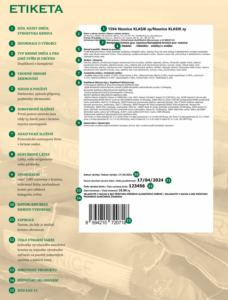
- product name,
- type of feed,
- intended animal species,
- manufacturer identification,
- instructions for use,
- list of feed materials,
- analytical constituents,
- content of additives,
- net weight of the package,
- date of manufacture,
- batch number,
- expiry date.
Without these details, the feed must not be placed on the market.
Product name
The label must include the product name. Czech legislation requires that the feed name clearly identifies the type and purpose of the product and must not be misleading. However, legislation does not explicitly require the label to state the form of the feed (pellets, meal, mash, etc.) or pellet size; this information is left to the manufacturer’s discretion.
Type of feed – complete or complementary feed
Distinguishing the feed type is essential for its inclusion in the feeding ration.Complete feed covers all daily nutrient requirements when the recommended dosage is followed. This type of feed is commonly used in large-scale poultry and rabbit farming, as well as in small poultry holdings. For laying hens, most feeds are complete, as they must cover the need for energy, proteins, and minerals for egg production. In broiler chickens, complete feeds are used according to age (starter, grower, finisher), as their nutrient requirements change rapidly.
Complementary feed is intended to supplement roughage or other components. It contains a more concentrated proportion of certain nutrients and would not be nutritionally balanced if fed alone. This type of feed is often used for rabbits in small-scale farming, where it is commonly combined with hay.
Manufacturer identification
The label must include the company name, address, and plant registration number. This entity bears full responsibility for the correctness of the composition and the safety of the feed and is subject to inspection by ÚKZÚZ. The registration of a feed business operator can be verified in the public register: Feed Business Operator Register.A registered manufacturer is subject to official supervision and must comply with requirements for production hygiene, raw material storage, and quality control. If a problem arises, a specific batch can be traced and addressed accordingly. Registration is therefore not a formality, but a guarantee of responsibility and traceability. Feeds from unregistered operators are not subject to official control or traceability systems, which poses a higher risk of unverified composition, insufficient production hygiene, and limited options for resolving potential health issues.
Instructions for use
Instructions for use on the label typically indicate the recommended dosage. They describe how the feed should be administered, for example mixed with roughage or fed alone, as well as any restrictions or warnings. The goal is to ensure that animals consume feed safely and in the correct quantity for optimal nutrition.
Composition (feed materials)
It is not mandatory to state the exact percentage of each ingredient on the feed label; listing them in descending order by weight is sufficient. This list shows which components dominate without revealing the exact formulation. Ingredients are listed in descending order based on their weight at the time of production. The first 3–4 feed materials usually have the highest share, although the difference between them may be as little as 1%, which is not always the case. The composition provides a basic idea of the nature of the feed, e.g. whether it is dominated by cereals, fibre-rich components, or oilseeds.
In poultry, pay particular attention to the proportion of cereals (wheat, maize) and the protein source (e.g. soybean meal). A lack of quality protein can lead to reduced laying performance or slower growth.
In rabbits, fibre content is crucial – the mix should contain alfalfa, dried grass, or other fibrous materials. Excessive cereal content can cause digestive problems.
Analytical constituents
Analytical constituents are standard laboratory parameters based on the so-called Weende analysis. The term “crude” (crude protein, crude fat, crude fibre, crude ash) means the total amount of the given component determined by a standard laboratory method, not a precise chemical breakdown of individual components.Crude protein indicates the total amount of nitrogenous substances (CP), i.e. the sum of all proteins in the feed. Laying hens typically require 15–18% CP depending on the production phase. Broiler chickens have higher requirements, especially in the starter phase (up to about 20–23%).
Crude fat is the total amount of fats and oils in the feed.
Crude fibre reflects the amount of insoluble fibre (cellulose, hemicellulose, lignin). In poultry it is lower, while in rabbits a higher fibre content is essential for proper digestive function and prevention of diarrhoea or bloating.
Crude ash represents the mineral residue after burning organic matter at high temperature. It indicates total inorganic content, important for bones, muscles, and other body functions.
Calcium, phosphorus, and sodium are macro minerals reported separately because their balance is crucial for bone metabolism, neuromuscular function, and acid-base balance. In feed for laying hens, calcium content is significantly higher (around 3.5–4%) to support eggshell formation. In rabbits, excessive calcium can be risky (e.g. may contribute to urinary stones), so “more” is not always better.
Starch and sugars are not mandatory analytical parameters; their declaration depends on the manufacturer. Their determination requires specific laboratory methods not included in basic Weende analysis, therefore they are not obligatory.
Feed additives
Feed additives are substances, microorganisms, or preparations that are not feed materials or premixes. They are used in very small amounts and do not include veterinary medicinal products.
- Technological – preserve feed, improve structure, extend shelf life.
- Sensory – improve palatability and attractiveness.
- Nutritional – enhance the nutritional value.
- Zootechnical – support digestion and animal performance.
- Coccidiostats and histomonostats – inhibit protozoa growth. They are common in broiler feeds due to coccidiosis. In rabbits, they may be used in feeds for fattening or young animals. If you keep animals under “medication-free” or organic systems, check that such additives are not present. These feeds are not suitable for all animals (e.g. laying hens).
Batch number
A batch is a specific production lot created in one production process. Each batch has a unique number allowing traceability of composition, production date, and quality control. This enables both manufacturer and breeder to trace origin and address issues such as complaints or product recalls.
Date of manufacture, expiry date
The date of manufacture indicates when the feed was produced and helps monitor freshness.
The minimum durability date (expiry date) indicates how long the feed retains its declared nutritional value and safety under proper storage. Expired feed may have reduced vitamin content, degraded fats, or increased microbial growth (bacteria, yeasts, moulds), which can compromise animal health. Therefore, feeding expired feed is not recommended.
Conclusion
The feed label provides a set of information that allows assessment of the product’s composition, nutritional value, and safety. A reliable, registered manufacturer who transparently provides all legally required data and is subject to official inspection offers breeders assurance of consistent quality and traceability. In animal nutrition, it is not only about the “composition on paper,” but also about consistent production, controlled raw materials, and responsibility for every batch produced.
Sources used in this article are available from the author, Ing. Lucie Humeni.